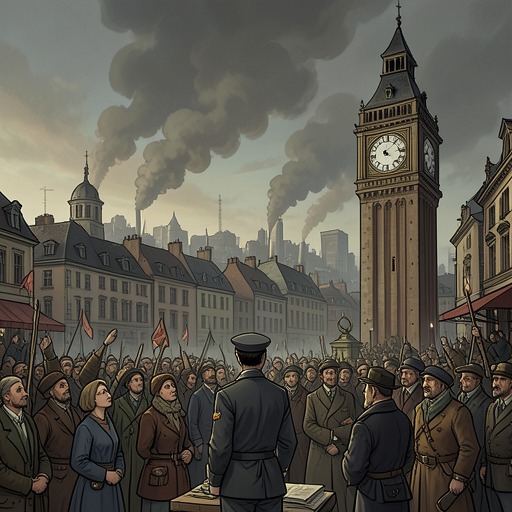
Second Great Fire of Chicago
The King in YellowThe Second Great Fire of Chicago is presented as a catastrophe whose decisive significance lies in its aftermath. The fire temporarily paralyzes Chicago, yet the city rises from its ruins as a white, imperial metropolis, transformed into something more beautiful than the white city built for the 1893 exhibition. In the book’s alternate national history, destruction becomes one stage in a broader programme of reconstruction, urban improvement, and centralized public order.
Causes and Historical Setting
Toward the end of 1920, the United States is described as outwardly tranquil and prosperous after a series of political, military, and administrative changes. The Second Great Fire of Chicago belongs to this background as a remembered crisis rather than a directly dramatized scene. Its importance is established through contrast: the fire had left Chicago, for a moment, practically paralyzed, but the city had not remained a ruin.
The event is also situated within a national culture increasingly committed to organized infrastructure and public management. Elsewhere, streets were widened, paved, and lighted; trees and squares were laid out; elevated structures were demolished and replaced by underground roads; and new government buildings, barracks, parks, theatres, and opera institutions expressed a belief that civic life could be deliberately redesigned. Chicago’s recovery therefore appears not as an isolated miracle but as the most spectacular example of a general political confidence in reconstruction.
The Fire and Immediate Disruption
The evidence gives no sustained description of the fire’s flames, victims, or exact course. What it does establish is the scale of its immediate effect: Chicago was “for a moment paralyzed after a second great fire.” That phrasing makes paralysis the event’s central visible consequence. The city’s normal functions were interrupted, and its later condition can be understood only against the severity of that interruption.
The omission of a spectacular fire scene is significant to the event’s narrative form. The disaster is not narrated through a single survivor’s testimony or through a sequence of burning streets. Instead, it appears in a compressed historical survey that measures catastrophe by the condition from which a city must recover. The event is therefore remembered less as a tableau of destruction than as a test of national resilience.
Reconstruction of Chicago
Chicago “had risen from its ruins, white and imperial,” and was described as more beautiful than the white city constructed for its “plaything” in 1893. The image joins recovery to architecture. Ruins are not merely cleared away; they become the ground for a city whose whiteness and imperial scale signal order, ambition, and renewed civic prestige.
This reconstruction also participates in the period’s wider replacement of bad architecture with good architecture. The rebuilt Chicago is consequently more than a restored version of what existed before the fire. It represents the possibility that disaster can authorize a cleaner and more coherent urban design. The city’s recovery supplies the national narrative with a concrete demonstration that calamity, however paralyzing at first, can be absorbed into a project of modernization.
Consequences and National Meaning
The Second Great Fire of Chicago functions as a counterpoint to the wars, political conflicts, and social measures that also shape the imagined United States of 1920. The country’s prosperity is not depicted as untouched innocence; it includes wars, fires, territorial interventions, and forceful governmental solutions. Yet the fire’s final place in the national story is affirmative. Chicago survives, improves, and becomes a visual emblem of the republic’s confidence in its own future.
Its significance is therefore double. On the level of urban history, the event causes temporary paralysis and demands reconstruction. On the level of the book’s political imagination, it validates the belief that coordinated institutions, public works, and architectural planning can turn catastrophe into renewal. The city rising white from its ruins embodies the larger contrast between apparent disorder at the moment of crisis and the expansive, highly managed calm that the government claims to have achieved by the end of 1920.